STRzero Carbon Strategy
Reducing emissions by 2040
With its STRzero carbon strategy, Flughafen Stuttgart GmbH is pursuing a clear goal: by 2040, its own operations are to be net greenhouse gas neutral. This means that the airport company, along with its energy subsidiary FSEG and its aircraft handling subsidiary SAG, will reduce their direct Scope 1 and 2 emissions – as defined by the Greenhouse Gas Protocol – by 2040, largely through measures implemented at their own sites. Any emissions remaining at that point must then be offset – that is, removed from the atmosphere.
The Energy and Climate Master Plan sets out the precise path to 2040. It defines the steps required to achieve this target.

Planned reduction pathway for greenhouse gas emissions (Scope 1 + 2) at Stuttgart Airport

2025, CO₂eq = CO₂ equivalents
Base year 1990: 15,927 CO₂eq; 2010: 35,484 CO₂eq
The target in detail
Stuttgart Airport will reduce its direct greenhouse gas emissions to net zero by 2040. In doing so, the airport is participating in the Net Zero Initiative launched by the European airport association, ACI Europe. Along the way, emissions in Scopes 1 and 2 , as defined by the Greenhouse Gas Protocol, by 85 per cent by 2030 compared with 1990 levels – starting from 15,927 CO2eq in 1990 (base year under the Baden-Württemberg Climate Protection Act) and 35,484 CO2eq in 2010 (base year under Airport Carbon Accreditation).
Furthermore, Stuttgart Airport is working towards carrying out all ground-handling activities at the aircraft – from landing to take-off – by 2030 in such a way that no CO2eq emissions or exhaust fumes are produced on site. This target encompasses the operations of Flughafen Stuttgart GmbH and its subsidiary Stuttgart Airport Ground Handling GmbH (SAG). To achieve this, all vehicles and equipment regularly used for ground handling operations there must be electrified.
The airport’s externally audited carbon footprint includes, under Scope 1 and Scope 2, the greenhouse gas emissions of the airport operator FSG, its energy subsidiary FSEG and its ground handling subsidiary SAG. They operate an environmental management system in accordance with EMAS.
In addition to the emissions caused directly by Stuttgart Airport, the carbon footprints of third parties are also included in the CO2eq balance (Scope 3) and taken into account in the strategy – these include, for example, emissions from airlines operating at the airport and from passengers. The airport supports the aviation sector in transforming air travel, for example by promoting the development of fuel cell propulsion systems. The expansion of other modes of transport, such as local and long-distance public transport by rail and road, is also actively encouraged.
The STRzero carbon strategy is based on the principle of avoiding emissions through technical solutions. Where this is not possible, greenhouse gas emissions are reduced to a minimum. Only as a final step are any remaining emissions offset.
The reduction pathway is continuously reviewed and the measures are adjusted accordingly. The annual integrated report transparently sets out how far Stuttgart Airport has progressed towards net greenhouse gas neutrality. The carbon footprint is calculated in accordance with internationally recognised standards and verified externally through the EMAS audit and the Airport Carbon Accreditation scheme.
Carbon footprint according to the Greenhouse Gas Protocol


Greatest influence on Scopes 1 and 2
The international Greenhouse Gas Protocol standard distinguishes between three scopes: Scopes 1 and 2 relate to emissionsgenerated in-house and those resulting from purchased energyrespectively , whilst Scope 3 covers emissions from third parties.
As the airport operator and its ground handling subsidiary SAG meet their electricity and heating requirements through their own energy subsidiary FSEG, the carbon footprint of the three companies is recorded on a consolidated basis under Scopes 1 and 2. The airport’s climate target relates to Scope 1 and 2.
Scope 3: Full flight vs. LTO cycle
The Greenhouse Gas Protocol stipulates that, when calculating their carbon footprint in terms of indirect emissions – i.e. Scope 3 – airports must account for the emissions from all departures (full-flight emissions). In the past, only the so-called landing and take-off cycle (LTO cycle) – that is, the emissions from aircraft during landing, taxiing, take-off and reaching cruising altitude – were attributed to airports under Scope 3.
What exactly are Scope 1, 2 and 3 in the context of an airport?
We explain this and many other terms from this page in our glossary.
Examples of specific measures under the STRzero carbon strategy:

Solar power from the airport
Local energy generation and storage
With the rising number of electric vehicles at the airport, the demand for electricity is also increasing. To meet this demand, the airport is expanding its solar installations.
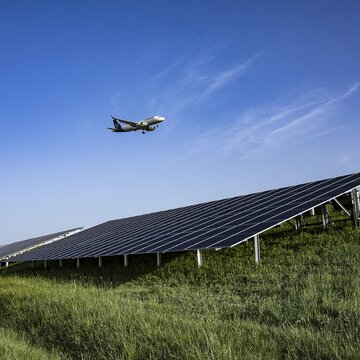
We currently generate solar power at seven locations across the campus: on the roofs of the Bosch car park, the Stuttgart Airport bus terminal, car park P11, the SkyPort building, the combined storage facility and an apron gate. Our first ground-mounted photovoltaic system is located to the west, within the airport perimeter fence.
The expansion of the photovoltaic systems at STR is a key investment focus of the Energy and Climate Master Plan.

Electric mobility
Ground handling, but without exhaust fumes
On the apron, we are increasingly turning to electric mobility. What began in 2013 with the first electric passenger bus has led to a fully battery-powered fleet of apron buses. The same applies to the baggage tugs at STR – these, too, are all emission-free. Taken together, all these electric vehicles and equipment already save around 1 million litres of diesel a year. This is a significant contribution to reducing CO₂eq emissions in aircraft ground handling.
E-mobility also has an impact on the working environment of our apron staff: air quality is improving and operations are becomingquieter.
Further investment in electric vehicles is planned as part of the implementation of the Energy and Climate Master Plan.

LED lighting
Switch saves energy
All 1,500 runway lights at Stuttgart Airport have been using LED technology since 2018. This made the STR runway one of the first in Europe to be fully equipped with LEDs .
Each LED light saves around half the energy that its predecessor used for lighting. The airport operator has also been gradually converting the lights on the taxiways.
The regional airport is striving to use energy as efficiently as possible. To achieve this, it is necessary to refurbish older buildings and thus make their operation more energy-efficient.The Energy and Climate Master Plan therefore provides for the refurbishment of some of the airport’s existing buildings.